

Void Filling Vero Beach FL
Empty pockets under concrete grow with every storm. Filling them early keeps slabs from cracking. Call 772-571-4702 for a free visit.
Family-Owned · Free Estimates · Lifetime Transferable Warranty
Call 772-571-4702Quick Answer
Void filling means pumping a lightweight material, usually polyurethane foam or grout, through small holes to fill the empty space left when soil washes out from under concrete. It supports driveways, walkways, patios and slabs, and it can raise a sunken one. Vero Beach Foundation Repair offers free estimates, and our repairs carry a lifetime transferable warranty.
What is a void under concrete?
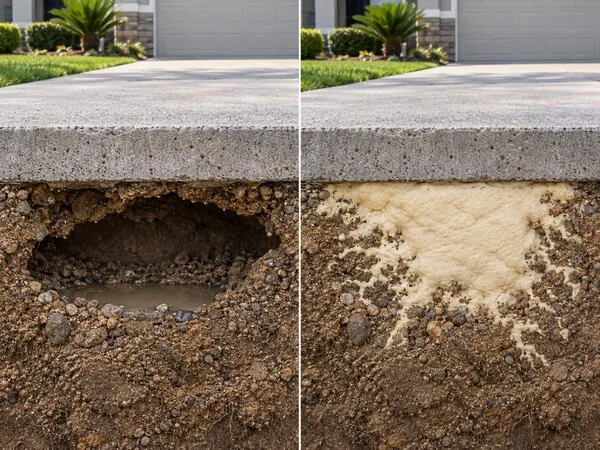
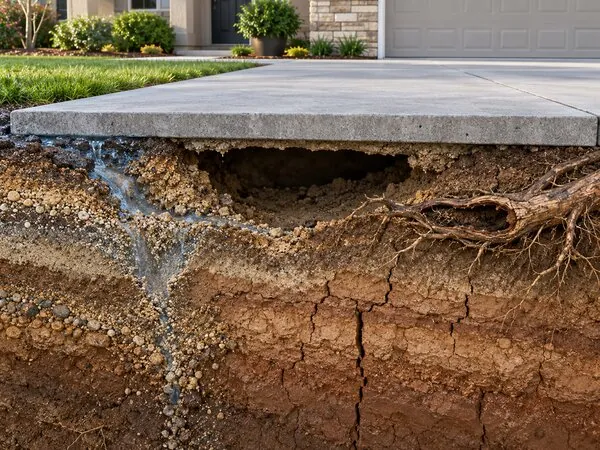
A void is a gap. Concrete is poured on soil, and over time water carries some of that soil away. The slab still looks flat, but it is bridging empty space. When a car, a delivery truck or a wet summer adds load, the unsupported concrete cracks or drops.
Voids start small. A tap with a hammer or a steel rod often gives them away: solid concrete rings, hollow concrete sounds dull and deep. A crack that runs along a line of low spots can be the first visible sign.
Why do voids form in Vero Beach?
The upper soil along this coast is mostly quartz sand, and sand moves easily with water. Roof runoff that dumps beside a walkway, an irrigation head that sprays under a patio, a broken drain pipe, tidal change near the lagoon and big afternoon storms all carry sand out from under slabs.
On the barrier island, sand is also near the water table. Salt water and rain move through it, and edges next to seawalls and canals can lose soil fast. That is why a failing wall and a sinking patio often show up together.
How are voids filled?
A crew drills small holes, about the size of a nickel, through the slab at planned spots. A hose carries material under the concrete. As the material expands or flows it fills the gap and, with enough volume, can lift the slab back toward its original height. The holes are then sealed.
Foam is the common choice because it is light, sets in minutes and does not add much weight to soft ground. Grout is another option where more bulk or strength is needed. The installer picks based on what is under the slab and what the slab carries. Our page on polyurethane foam injection covers the foam method in detail.
What kinds of slabs can be filled?
If the concrete itself is badly broken or crumbling, replacement may be the better choice. A visit will say.
- Driveways, aprons and sidewalks that dip or crack
- Patios, lanais and pool decks with low spots
- Garage slabs and steps that have dropped
- Slabs beside a seawall, where soil may have leaked through
- Parking lots and loading areas at businesses
Should the cause be fixed too?
Yes. Filling a void without fixing the leak or the runoff that made it is a short-term fix. If water is still moving through the soil, new gaps can open. Look at gutters, downspouts, irrigation and any cracked pipes.
If the ground itself is weak, soil stabilization adds strength under the filled area. If the problem is near a wall at the water, seawall repair may need to come first.
What does void filling cost?
Cost follows the area, how big the voids are and what material is needed. Filling a small walkway is a short visit. A long driveway or a parking lot needs more material and time. Compared with tearing out and re-pouring concrete, filling is often a fraction of the price, but only when the slab is still sound.
Estimates are free. Ask what material is planned and what the warranty covers. Our repairs carry a lifetime transferable warranty.
Do I need a permit?
Filling under a driveway or walk often needs no building permit, but rules differ by city and county. Work close to a seawall, near the beach or in a flood zone can bring extra review. A quick call to the building office that covers your address settles it. For oceanfront property, remember that Florida DEP regulates construction seaward of the state coastal line.
How soon after a storm should I check for voids?
Walk the driveway, patio and pool deck within a week or two after a heavy rain or a named storm. Tap suspicious spots and look for new hairline cracks, standing water that was not there before and slabs that rock when you step on a corner. Small voids are cheaper to fill than large ones, and they tend to grow.
Where we fill voids
We fill voids across the Vero Beach area, from Indian River Shores to Hutchinson Island South. If your pool deck is part of the problem, see pool stabilization. To book a visit, use the contact page.
Void Filling FAQs
How can I tell if there is a void under my slab?
Tap with a hammer. Hollow, dull sounds point to a gap. A slab that dips, rocks, or shows a crack along a low line is another sign.
How long does void filling take?
A small area can be done in a couple of hours. Larger jobs take a day or more.
Can I use the driveway right away?
With foam, often within minutes to hours. Ask the crew for the cure time for the material they use.
Will the holes show?
They are small and are sealed when the work ends. They can be patched to blend in.
Is foam safe for the soil and the groundwater?
Cured polyurethane foam is inert. Ask your installer for the product data sheet if you want the details.
Does it fix the cause?
Not by itself. Fix leaks and drainage too, or voids can reopen.
Where We Work
- Void Filling in SebastianWe serve Sebastian and nearby
- Void Filling in Port St. LucieWe serve Port St. Lucie and nearby
- Void Filling in StuartWe serve Stuart and nearby
- Void Filling in Hutchinson Island SouthWe serve Hutchinson Island South and nearby
- Void Filling in Indian River ShoresWe serve Indian River Shores and nearby
Get Your Void Filling Estimate
Call 772-571-4702 or send the form. We will set up a free visit.